Japanese food: a guide to the main dishes and how a Japanese meal is built
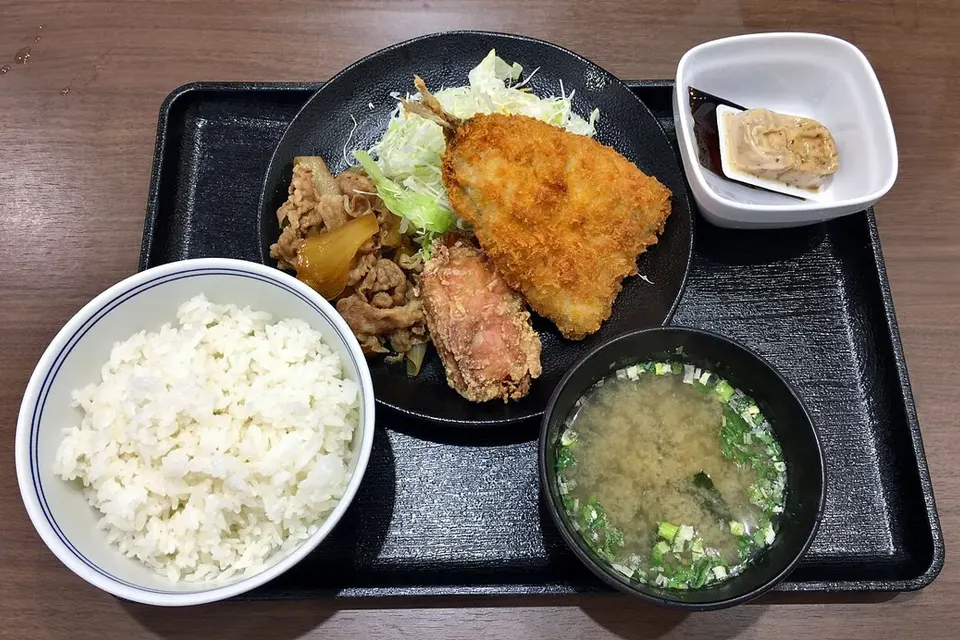
Ask someone outside Japan to name a Japanese food and you will probably hear sushi or ramen. Ask someone in Japan what they had for dinner and the answer is more likely to be rice, miso soup, grilled fish and a couple of small vegetable dishes. Both answers are Japanese food. This guide starts with the everyday meal, because it explains almost everything else, and then goes through the main families of dishes, with the Japanese word for each and a link to our longer guides where we have one.
- The everyday Japanese meal is built around rice and soup, with one main dish and one or two side dishes: ichiju sansai, "one soup, three dishes".
- Its foundations are dashi (stock), soy sauce, miso and rice, plus pickles on the side.
- Restaurant favourites such as sushi, tempura, ramen and tonkatsu are only part of the picture; many are specialities eaten out rather than cooked at home.
- Washoku, traditional Japanese food culture, was inscribed by UNESCO in 2013 as intangible cultural heritage.
How a Japanese meal is built
The Ministry of Agriculture, Forestry and Fisheries (MAFF) describes the standard washoku meal as rice and soup served alongside one main meat or fish dish and one or two side dishes of vegetables, mushrooms or seaweed. This pattern is called 一汁三菜 ichiju sansai, "one soup, three dishes", and the ministry presents it as a well-balanced way of eating that leans on umami rather than animal fat.
In practice, a home meal set out this way looks like this:
| Part | Japanese | Typical examples |
|---|---|---|
| Staple | ご飯 gohan | A bowl of plain short-grain rice; see rice in Japan. |
| Soup | 汁物 shirumono | Miso soup most days, clear soup (suimono) on special occasions; see making miso soup. |
| Main dish | 主菜 shusai | Grilled fish, simmered fish, ginger pork, tofu dishes, a piece of fried chicken. |
| Side dishes | 副菜 fukusai | Spinach with sesame (goma-ae), simmered vegetables (nimono), a small salad, seaweed. |
| On the side | 漬物 tsukemono | Pickles; see Japanese pickles. |
Rice sits on the left, soup on the right, the main dish behind them. Everything arrives together rather than in courses, and you move between bowls as you eat. The same structure appears in restaurant set meals (定食 teishoku), in school lunches and in the breakfast tray of a traditional inn. How to hold the bowls and use chopsticks with it is covered in our guide to chopstick etiquette and table manners.
The flavours underneath
A handful of ingredients give Japanese food its taste. Dashi, a quick stock made from kombu seaweed and dried bonito flakes, is in soups, simmered dishes and noodle broths; see our dashi guide. Soy sauce comes in several styles, from dark koikuchi to pale usukuchi (soy sauce types). Miso, fermented soybean paste, flavours soup, marinades and dressings. Mirin, sake, rice vinegar and a little sugar complete the pantry. Fermented foods run through all of it, from miso to natto. For the vocabulary you meet on packets and menus, our glossary of Japanese home cooking explains 120 of them.
The main dishes, family by family
Raw and lightly cured fish
- Sashimi (刺身): slices of very fresh raw fish or seafood, eaten with soy sauce and wasabi, without rice.
- Sushi (寿司): vinegared rice with toppings. Nigiri is hand-pressed rice under a slice of fish; maki is rolled in nori; chirashi is toppings scattered over a bowl of rice. At home, sushi is mostly a celebration dish.
Grilled, simmered and fried
- Yakimono (焼き物): grilled foods, above all salted fish such as mackerel or salmon, and yakitori, chicken skewers grilled over charcoal.
- Nimono (煮物): vegetables, tofu or fish simmered in dashi, soy sauce and mirin, such as nikujaga, meat and potatoes.
- Tempura (天ぷら): seafood and vegetables in a thin, light batter, fried and eaten with a dipping sauce or salt.
- Tonkatsu (とんかつ) and karaage (唐揚げ): breaded pork cutlet, and marinated fried chicken, both everyday favourites.
Noodles
- Ramen (ラーメン): wheat noodles in a rich broth, flavoured with soy sauce, salt, miso or pork bone (tonkotsu). Of Chinese origin, now with regional styles across Japan.
- Udon (うどん): thick, chewy wheat noodles, served hot in dashi broth or cold with a dip.
- Soba (そば): thin buckwheat noodles, often served cold on a bamboo tray in summer, and eaten on New Year's Eve as toshikoshi soba; see Japanese New Year.
Rice dishes
- Donburi (丼): a bowl of rice with a topping, such as gyudon (simmered beef), oyakodon (chicken and egg) or katsudon (pork cutlet and egg).
- Onigiri (おにぎり): rice balls with a filling, wrapped in nori, the lunchbox staple.
- Japanese curry (カレーライス): a thick, mild curry over rice, a family favourite and a fixture of school lunches.
Pots, soups and the table
- Nabe (鍋): hot pots cooked at the table in winter, from yosenabe to sukiyaki; see nabe at home.
- Okonomiyaki (お好み焼き): a savoury cabbage pancake, cooked on a griddle, associated with Osaka and Hiroshima.
Sweets
- Wagashi (和菓子): traditional sweets made from rice, beans and sugar, often shaped to match the season and served with green tea.
- Mochi (餅): pounded glutinous rice cakes, central to the New Year; see mochi.
Regional food
Japanese food varies far more by region than the restaurant menus abroad suggest: miso is sweeter in some places and saltier in others, broths are darker in Tokyo and paler in Kansai, and Okinawa has a cuisine of its own, with pork, bitter melon and tofu stir-fries (Okinawan home cooking). MAFF maintains a database called Our Regional Cuisines, which describes the origin, history and recipes of local dishes chosen by regional committees, prefecture by prefecture. It is the best place to start if you want to go beyond the dishes above.
Washoku as heritage
In 2013, UNESCO added washoku, the traditional dietary cultures of the Japanese, to its list of intangible cultural heritage. The inscription is not about a list of dishes. It describes a social practice "associated with an essential spirit of respect for nature", which favours local ingredients such as rice, fish, vegetables and edible wild plants, and is most visible at New Year, when families prepare special dishes with symbolic meanings. UNESCO notes that the basic skills, such as the proper seasoning of home cooking, are passed down at shared mealtimes at home.
That is a useful way to think about Japanese food in general: less a set of famous recipes than a way of putting a meal together, around rice, soup and the season.
Sources
- Ministry of Agriculture, Forestry and Fisheries (MAFF), Washoku World Challenge: learning about washoku, consulted November 2026.
- Ministry of Agriculture, Forestry and Fisheries (MAFF), Japanese Cuisine, consulted November 2026.
- Ministry of Agriculture, Forestry and Fisheries (MAFF), Our Regional Cuisines, consulted November 2026.
- UNESCO, Washoku, traditional dietary cultures of the Japanese, notably for the celebration of New Year, inscribed 2013.
 Home cooking
A glossary of Japanese home cooking
From awase dashi to yuzu kosho: the words you meet in Japanese recipes and shops, explained in one or two lines each.
 Home cooking
Rice in Japan, and how to cook it
Short-grain rice, washed and soaked, cooked by absorption and rested: the method, the ratios and the onigiri that follow.
 Home cooking
Making miso soup and choosing miso
Rice, barley or soybean koji; white, red or mixed: how to choose a miso, and the one rule for miso soup.