Mochi: Japan's rice cakes, from mochitsuki to New Year soup
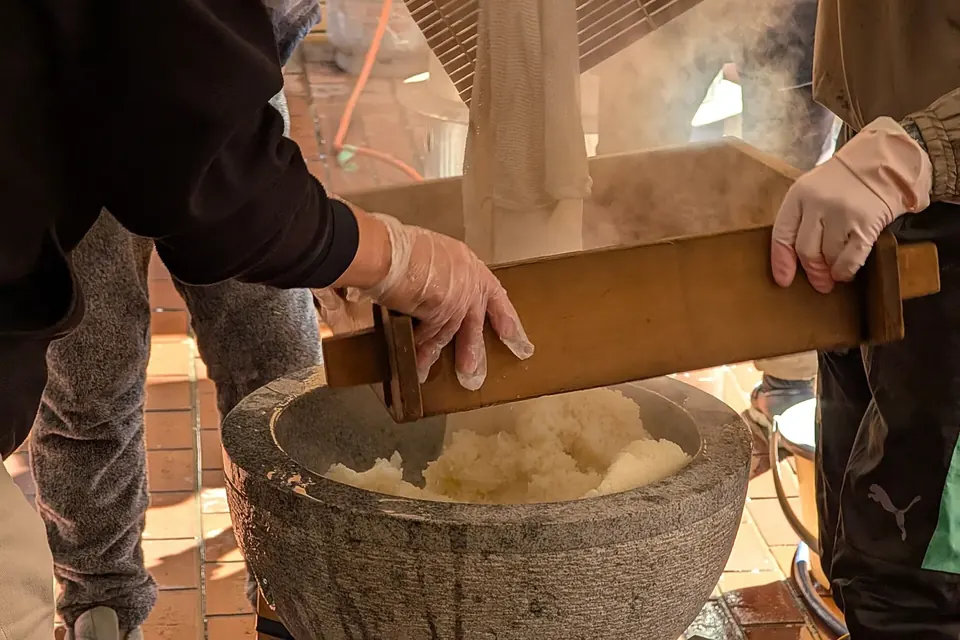
Mochi is glutinous rice that has been steamed and pounded into a smooth, elastic dough. It is eaten all year, in sweets and in savoury dishes, but its real season is the turn of the year, when it is pounded in neighbourhoods, stacked on household altars and dropped into the New Year soup. Here is what mochi is, how it is made, how its shape changes from region to region, and how to cook and eat it safely.
- Mochi is made from mochigome, a glutinous short-grain rice, steamed and then pounded.
- Mochitsuki, pounding with a mortar and mallet, is a year-end event in many communities.
- Eastern Japan mostly uses square mochi, western Japan round mochi; the line runs near Sekigahara.
- Mochi is a choking hazard, especially for older people: cut it small and eat slowly.
What mochi is
Japanese rice comes in two broad kinds. Ordinary table rice (uruchimai) is the short-grain rice eaten every day. Glutinous rice (mochigome) is a different variety whose starch is almost all amylopectin, which makes it very sticky when cooked. It contains no gluten despite the name. Our guide to rice in Japan explains the everyday kind.
To make mochi, mochigome is soaked overnight, steamed until translucent, and pounded while hot until the grains disappear into a smooth mass. The dough is then shaped while warm: torn into balls, rolled out into a slab and cut, or formed into the stacked discs used as New Year offerings. Fresh mochi is soft and stretchy. It hardens within a day or two, which is why it is often dried, grilled or simmered before eating.
Mochitsuki: pounding the rice
Traditional mochitsuki uses an usu, a large mortar of wood or stone, and a kine, a heavy wooden mallet. One person swings the mallet. A second person kneels by the mortar and, between blows, wets their hand and turns the dough. The rhythm has to be steady and the trust complete. A few dozen blows turn a mortar of steamed rice into mochi.
In December, schools, neighbourhood associations, shrines and community centres hold mochitsuki events where children and visitors take a turn with the mallet and the fresh mochi is shared out with sweet bean paste, kinako (roasted soybean flour) or grated daikon and soy sauce. Most households now buy ready-made mochi or use an electric mochi maker, which steams and kneads the rice in one machine, but the public pounding remains one of the most visible signs that the year is ending.
Mochi at the New Year
Kagami mochi
Kagami mochi, "mirror mochi", is two round flat cakes of mochi stacked one on top of the other, usually topped with a small bitter orange (daidai) and set on a stand on the household altar, in the alcove or near the entrance. It is an offering to the deity of the new year. In early January the dried, cracked cakes are broken up (traditionally by hand or with a mallet, never cut with a knife) and eaten, often in sweet red bean soup. This ritual is called kagami biraki, "opening the mirror". Our guide to the Japanese New Year covers the other customs of the first days of January.
Zoni
Zoni is the soup eaten on the morning of New Year's Day, and almost every region and family has its own version. The constant is mochi. The broth can be a clear stock seasoned with soy sauce, a white miso soup, or occasionally a sweet red bean soup, and the vegetables, fish and chicken that go into it vary by local produce.
Round or square: the regional line
The Ministry of Agriculture, Forestry and Fisheries has mapped the most visible difference between regional zoni: the shape of the mochi. According to the ministry, mochi was originally round. In the Edo period people began rolling mochi out into slabs and cutting it into pieces, which made square mochi, and the square shape spread from Edo because it was quicker to make and easier to carry.
The dividing line today runs roughly through Sekigahara in Gifu Prefecture. Prefectures to the east generally use square mochi and those to the west generally use round mochi. The prefectures on the line, Gifu, Ishikawa, Fukui, Mie and Wakayama, have places that use both. There are exceptions on each side: the Shonai area of Yamagata and Ichinoseki in Iwate use round mochi, while Kochi and Kagoshima in the west use square mochi. The ministry links these western exceptions to their feudal lords' long stays in Edo.
Regions and families also differ in whether the mochi is grilled before it goes into the soup or simmered soft in the broth, and in whether the soup is seasoned with soy sauce or miso.
Mochi through the rest of the year
Mochi sweets, sold in Japanese confectionery shops (wagashi-ya), follow the seasons:
- Spring: sakura mochi, pink rice wrapped in a salted cherry leaf, appears around the Girls' Festival in March and the cherry blossom season. Kusa mochi is coloured and flavoured with mugwort.
- Early summer: kashiwa mochi, filled with bean paste and wrapped in an oak leaf, is eaten for Children's Day on 5 May.
- All year: daifuku, soft mochi stuffed with sweet bean paste, sometimes with a whole strawberry inside in winter and spring.
- Autumn: tsukimi dango, small white rice dumplings stacked for the harvest moon, are made from rice flour rather than pounded rice, but belong to the same family.
Savoury mochi is just as common: grilled and wrapped in nori with soy sauce (isobe-yaki), added to udon as chikara udon ("strength udon"), or deep-fried as crackers.
Cooking dried mochi at home
Supermarkets in Japan and Asian grocers abroad sell kirimochi, individually wrapped dried blocks of mochi that keep for months.
- To grill: place the blocks in a toaster oven or on a grill, a little apart, and cook for 6 to 10 minutes until they puff up and brown in spots. Watch them: they swell suddenly.
- To boil: drop the blocks into simmering water or broth for 3 to 5 minutes until soft right through.
- To microwave: put a block in a bowl of water and heat for about 1 minute. It turns very soft quickly, so check often.
- Serve grilled mochi with soy sauce and nori, with kinako and sugar, or in soup.
Eating mochi safely
Mochi is sticky, elastic and hard to break up in the mouth, and every New Year it causes choking accidents in Japan. The Consumer Affairs Agency analysed deaths from choking on mochi among people aged 65 and over in 2018 and 2019: there were 661 in two years, and 43% of them happened in January. The agency's advice, repeated by local governments, is simple:
- Cut mochi into small pieces that are easy to eat.
- Drink some tea or soup first to moisten the throat, but do not wash mochi down before chewing it.
- Take small bites and chew slowly and thoroughly before swallowing.
- Keep an eye on older relatives and small children while they eat mochi.
If someone is choking and cannot breathe or speak, call the emergency number (119 in Japan) at once.
Sources
- Ministry of Agriculture, Forestry and Fisheries, "Regional differences in the shape of mochi" (in Japanese), consulted October 2026.
- Gunma Prefecture, Food and Living Hygiene Division, food safety newsletter vol. 179, December 2021, citing the Consumer Affairs Agency's analysis of mochi choking deaths (in Japanese).
- Consumer Affairs Agency, year-end warning on choking accidents with mochi, consulted via the Gunma Prefecture newsletter above.
- Ministry of Agriculture, Forestry and Fisheries, Hokkaido Regional Agricultural Administration Office, materials on regional zoni, consulted October 2026.
 Seasons and festivals
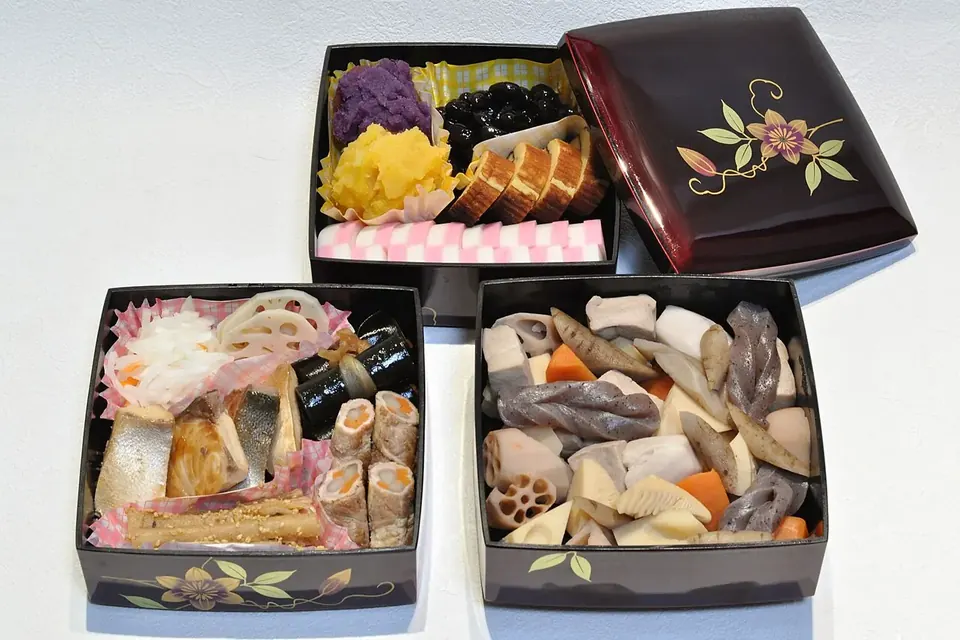
Japanese New Year: shōgatsu
Year-end cleaning, temple bells, osechi boxes, the first shrine visit and money for children: the year's biggest holiday, day by day.
 Japanese home cooking
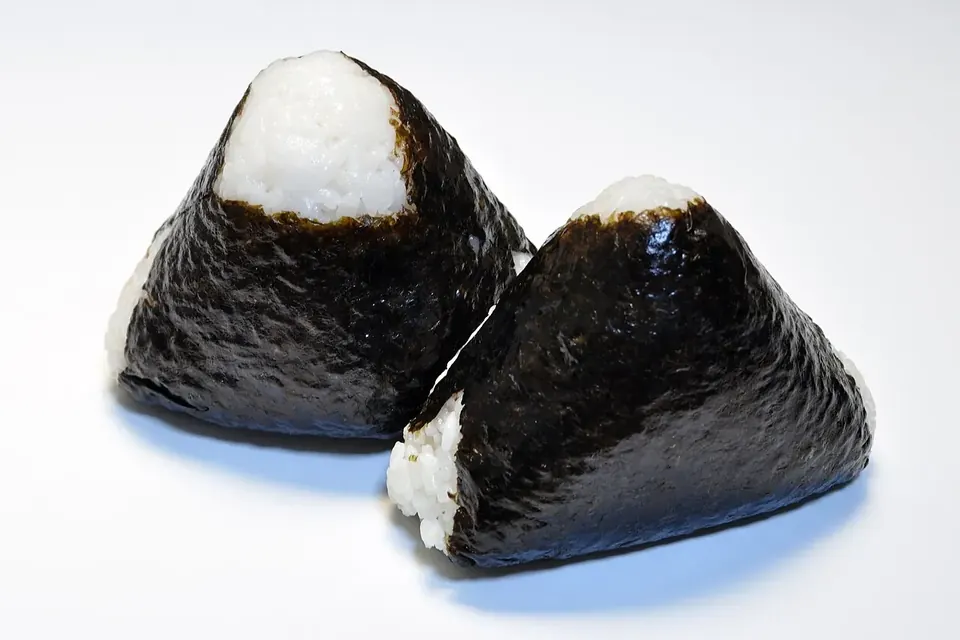
Rice in Japan, and how to cook it
Short-grain rice, washed and soaked, cooked by absorption and rested: the method, the ratios and the onigiri that follow.
 Seasons and festivals
Hanami and the cherry blossom season
How the Japan Meteorological Agency declares the blossoms open, why it starts in Okinawa, and picnic etiquette under the trees.