Nabe: Japanese hot pot at home, from yosenabe to sukiyaki, and how to cook one at the table
When the evenings turn cold, the most common Japanese answer to the question “what shall we eat?” is a pot. A burner goes in the middle of the table, a clay or iron pot of broth goes on it, and a platter of raw vegetables, tofu, mushrooms and meat or fish is set beside it. Everyone adds ingredients, waits, fishes out what is cooked, and adds more. This is nabe, short for nabemono, “things in a pot”: less a single dish than a way of eating, and one of the easiest pieces of Japanese home cooking to bring into any kitchen.
- What: a hot pot cooked and kept simmering at the table, shared by everyone around it.
- Two families: light kombu broths with a dipping sauce, such as yudōfu and mizutaki, and seasoned broths eaten as they are, such as yosenabe and sukiyaki.
- The pot: a clay donabe, which stays hot off the heat, or a heavy iron pot, the classic choice for sukiyaki.
- The ending: the shime, rice or noodles cooked in the broth that is left at the end.
One word, many pots
Nabe simply means “pot”, and in a Japanese kitchen the word covers any saucepan. At the table, though, it means a shared hot pot. The dishes that go by the name are stews and soups served while still bubbling, kept hot by a portable stove, with diners picking out the ingredients they want and adding more as the meal goes on. In most homes the burner is a tabletop gas stove running on a slim butane canister, or an electric hot plate or induction ring; in the past it was a charcoal brazier.
The pot itself matters. A donabe is a thick, glazed earthenware pot with a heavy lid. It heats slowly but holds heat well, so the broth keeps simmering gently and stays hot for a while after the flame is turned off. A tetsunabe, a shallow cast-iron pan, spreads heat evenly and is the classic vessel for sukiyaki, where the beef is seared before the sauce goes in. Any wide, heavy, flameproof pot works on a portable stove, provided it does not overhang the burner.
Light broths and seasoned broths
Japanese hot pots fall broadly into two families.
In the first, the broth is light, often just water with a piece of kombu, and the flavour comes at the table from a dipping sauce. Yudōfu, tofu warmed in kombu stock and eaten with ponzu and condiments, is the simplest. Mizutaki, associated with Fukuoka, simmers chicken on the bone with vegetables in a plain stock, and each mouthful is dipped in ponzu. Shabu-shabu, in which wafer-thin slices of beef or pork are swished through the simmering stock for a few seconds and dipped in sesame or ponzu sauce, belongs here too.
In the second family, the broth is seasoned and eaten as it is. Yosenabe, whose name means roughly “gathered together”, is the everyday home hot pot: a dashi seasoned with soy sauce, mirin or miso, into which go whatever fish, chicken, tofu and vegetables the household has. Sukiyaki cooks thinly sliced beef, tofu, leeks, mushrooms and shirataki noodles in a sweet soy sauce and dips each bite in beaten raw egg. Oden, daikon, eggs, konnyaku and fishcakes stewed for a long time in a light soy dashi, is sold from simmering trays in convenience stores all winter.
Both families depend on a good stock. Our guide to dashi explains kombu, bonito and shiitake stocks, any of which can be the base of a home nabe.
A map in pots
Almost every region has a hot pot of its own, built around what grows or is caught locally. A few of the best known:
- Ishikari-nabe (Hokkaido): salmon and vegetables in a miso broth.
- Kiritanpo-nabe (Akita): chicken, burdock, leeks and Japanese parsley with kiritanpo, rice pounded onto skewers and toasted.
- Hōtō (Yamanashi): broad, flat wheat noodles simmered in miso with kabocha squash and other vegetables.
- Dote-nabe (Hiroshima): oysters and vegetables cooked in a pot whose rim is lined with miso, which melts gradually into the broth.
- Motsunabe (Fukuoka): beef or pork offal with cabbage and garlic chives, in a soy or miso broth.
- Chankonabe: the hearty, ingredient-packed hot pot associated with sumo stables.
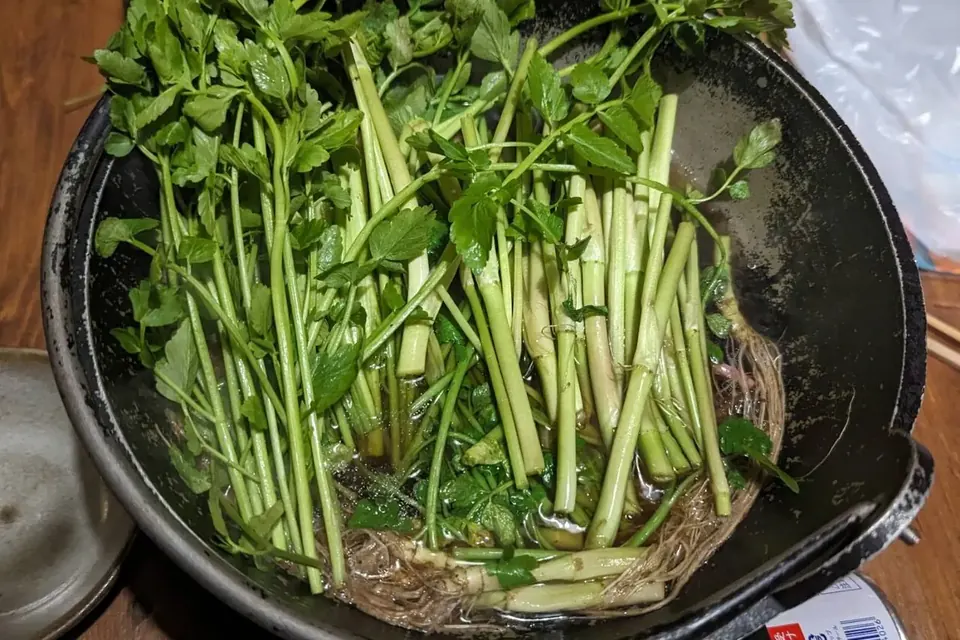
The newest arrival on this map is the hot pot in the photograph above. Japanese parsley, seri, has long been grown around Sendai, in Miyagi Prefecture, and in March 2024 “Sendai seri” was registered under Japan's geographical indication scheme, the system that protects regional products. The registration, published by the Ministry of Agriculture, Forestry and Fisheries, says that seri cultivation there began in the Edo period, when wild plants from wetlands fed by the underground water of the Natori River were improved and grown as a crop, and that in recent years seri nabe, in which the plant is eaten whole down to its roots, has become a Sendai specialty. The roots, cleaned and simmered briefly, are the part many people go for first.
Cooking a yosenabe at the table
A home hot pot needs no recipe so much as an order of work.
- Make the broth. Use dashi seasoned with soy sauce and mirin, or dashi with miso stirred in, tasting as you go. It should taste pleasant to drink on its own, a little lighter than a soup, because it will reduce at the table.
- Prepare a platter. Cut everything into pieces that cook in a few minutes: chicken thigh or white fish in chunks, firm tofu in cubes, napa cabbage, leeks or spring onions, carrot and daikon in thin slices, mushrooms such as shiitake, enoki or shimeji, and a leafy green such as shungiku or mizuna.
- Start with what takes longest. Bring the broth to a simmer in the kitchen, carry it to the table, and add root vegetables, the thick white stems of the cabbage, and meat or fish first.
- Add the quick things as you eat. Tofu, mushrooms and cabbage leaves go in next; greens need only a minute and go in last, a handful at a time.
- Keep it simmering, not boiling hard. A gentle simmer keeps tofu whole and fish tender. Skim off foam now and then, and top up with broth or water if it reduces too far.
Raw meat and fish should stay on their own plate with their own chopsticks or tongs, and every piece should be cooked through before it is eaten, exactly as in any other kitchen. Thin slices cook in moments; chunks of chicken take longer than they seem to.
The shime: the best part comes last
By the end of the meal, the broth has taken on the flavour of everything that has cooked in it, and nobody wastes it. The shime, the closing dish, turns it into a final course. Cooked rice can be stirred in and simmered into zōsui, often finished with a beaten egg poured over and a scattering of spring onion; a block of udon or a portion of ramen noodles can be cooked in it instead. Many families plan the meal around the shime, keeping back a bowl of rice for the purpose; our guide to rice in Japan explains how to cook it.
Around a shared pot
A nabe is eaten from a common pot, so a few habits keep it pleasant for everyone. Use the serving chopsticks or ladle provided to take food from the pot rather than your own chopsticks, or, among close family, turn your chopsticks around and use the other end. Take what you will eat rather than picking through the pot for the best pieces, and keep adding ingredients for others as well as yourself. Our guide to chopstick etiquette covers the wider rules of the table.
In winter, the hot pot often goes on the same table as the kotatsu, which makes for the most comfortable meal of the Japanese year. If you do this, keep the cable of the heater and the hot pot well apart, set the stove on a stable, flat surface, and follow the instructions for your burner: a portable gas stove should not be covered by a pot wider than its plate, should be kept away from other heat sources, and should have its canister removed and stored safely after use.
Sources
- Ministry of Agriculture, Forestry and Fisheries of Japan, “第149号:仙台せり” (Geographical indication No. 149: Sendai seri), registration of 27 March 2024 (production area, history of cultivation, seri nabe as a Sendai specialty), consulted November 2026.
- Wikipedia, “Nabemono” (definition, the two families of broth, donabe and tetsunabe, varieties and regional hot pots), consulted November 2026.
- The safety points on portable stoves follow the general instructions given by makers of tabletop gas burners; check the instructions for your own stove.
 Japanese home cooking
Dashi, the stock behind Japanese cooking
Kombu, katsuobushi, shiitake and niboshi: how each dashi is made, and why umami was discovered in a pot of it.
 Homes and small spaces
The kotatsu and winter at home
A low table, a heater underneath and a quilt over everyone's knees: how the kotatsu works, where it came from, and how to use one safely.
 Japanese home cooking
Rice in Japan, and how to cook it
Short-grain rice, washed and soaked, cooked by absorption and rested: the method, the ratios and the onigiri that follow.