The genkan and shoes-off homes: how Japan draws the line between outside and inside
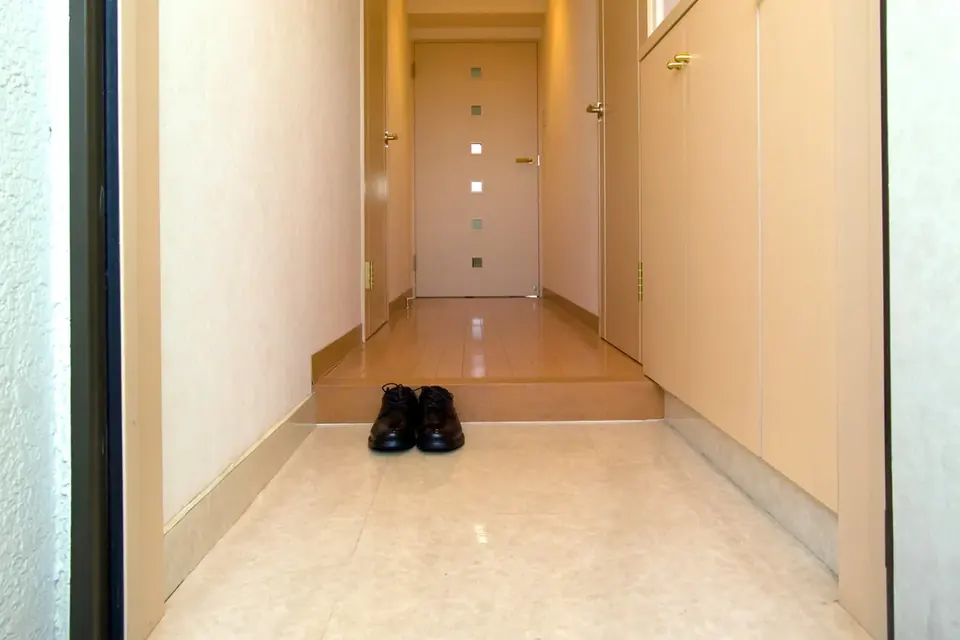
Step into almost any Japanese home and the first thing you do is stop. The front door opens onto a small area of stone or tile, a step lower than the rest of the house, where shoes come off and stay. This is the 玄関 genkan. It is a practical way to keep dirt out of rooms where people sit and sleep on the floor, and a social threshold that every visitor learns to cross in the same way.
- Take shoes off in the lower part of the genkan, then step up onto the raised floor without putting a shoe on it.
- Turn your shoes to face the door, or set them neatly to the side, so they are ready when you leave.
- Slippers are for corridors and wooden floors, not for tatami. Toilets often have their own slippers.
- Expect shoes-off spaces beyond homes: some restaurants, temples, ryokan, schools, clinics and changing rooms.
What a genkan is
The genkan has two levels. The lower part, the tataki, is at roughly the level of the ground outside and is finished in stone, tile or concrete. The step up to the main floor is called the agari-kamachi, a wooden edge marking where "inside" begins. Next to it is the getabako, a shoe cabinet whose name recalls wooden geta sandals. In a large old house the genkan may be a spacious hall; in a city flat it can be a strip of tile barely wide enough to turn around in, but the step and the habit remain.
The reason is partly practical. Traditional Japanese rooms are floored with tatami, which is sat and slept on, and wooden floors are wiped rather than scrubbed. Keeping street dirt, mud and rain at the door makes floor-level living possible. Our guide to tatami mats explains why the mats themselves can't take shoes.
How to enter a Japanese home
- Say hello at the door. Visitors often say ojama shimasu ("I'm intruding") as they come in.
- Take your shoes off while standing on the lower level. Avoid stepping onto the raised floor in shoes, or in socks onto the dirty tataki and then back up.
- Step up, then turn. Once inside, turn around, crouch and set your shoes neatly together, toes pointing towards the door. Some hosts will do this for guests; let them.
- Put on slippers if offered, usually lined up for you.
- When leaving, step down directly into your shoes. A shoehorn is often kept by the door.
Because shoes come off often, people pay attention to socks: clean, without holes, and easy to remove shoes without laces are practical choices for a day of visits, temples or restaurants with tatami rooms.
The slipper system
Inside many homes and traditional inns there are layers of floor, each with its own footwear:
| Area | Footwear | Notes |
|---|---|---|
| Outside, tataki of the genkan | Shoes | Shoes never go past the step |
| Wooden corridors and Western-style rooms | House slippers or socks | Slippers are offered to guests in many homes |
| Tatami rooms | Socks or bare feet | Leave slippers outside the room |
| Toilet | Toilet slippers | Kept inside the toilet door; take them off when you leave |
| Bathroom (washing area) | Bare feet | Sometimes plastic bath slippers |
The classic visitor mistake is to walk out of the toilet still wearing the toilet slippers. It happens to everyone once.
Where else shoes come off
- Temples and some shrine buildings: before entering halls with tatami or wooden floors. See our guide to visiting shrines and temples.
- Ryokan (traditional inns): often at the entrance, with slippers provided.
- Restaurants with tatami seating (zashiki or ozashiki): shoes off before the raised area, sometimes into numbered lockers.
- Schools: pupils change into indoor shoes (uwabaki) at shoe lockers.
- Clinics, some offices, fitting rooms in clothes shops: follow the slippers, mats or signs.
A raised floor, a line of slippers or a sign with a crossed-out shoe are reliable clues.
Indoor shoes at schools and workplaces
The same logic applies outside the home. Japanese schools have rows of shoe lockers at the entrance, where pupils change into light indoor shoes; outdoor shoes never enter the classrooms. Some offices, hospitals and older public buildings provide slippers at the door, and changing rooms in clothing shops usually ask you to step out of your shoes onto a mat. In each case the cue is the same as at home: a change of floor level or surface, and footwear lined up at the edge.
The genkan as a threshold
The genkan is also where much of daily life with the outside world happens: deliveries are signed for, neighbours chat, umbrellas drip, and guests who are only dropping by are received without being invited further. The distinction between uchi (inside, one's own group) and soto (outside) is a common theme in writing about Japanese society, and the genkan is its most visible architectural expression.
Making a genkan anywhere
Shoes-off homes are common in many countries, and a genkan-like entrance makes them easier to live with, especially in small flats:
- Mark the boundary with a different floor surface, a washable mat or a low step if possible.
- Store shoes vertically in a slim cabinet or rack by the door.
- Add a seat or a stool for putting shoes on, and a shoehorn.
- Keep a basket of guest slippers or socks.
- Hooks for bags and coats, so they stop at the door too.
In a small apartment, this single change keeps more clutter out of the living space than almost any storage you could buy. Our guide to living small the Japanese way shows how it fits into a whole-flat plan.
Sources
- Ministry of Foreign Affairs of Japan, Kids Web Japan, "Why do Japanese people take off their shoes at home?", web-japan.org, consulted October 2026.
- Ministry of Foreign Affairs of Japan, Kids Web Japan, quiz on genkan manners (turning shoes to face the door), web-japan.org.
- Nipponia magazine no. 20 (2002), feature on the traditional genkan, published on web-japan.org.
 Homes and small spaces
Living small the Japanese way
Rooms that change use, storage in the walls, sliding doors and a real entrance: lessons from Japanese homes for any small flat.
 Homes and small spaces
Tatami mats and room sizes
Kyoma, Edoma and danchi-ma: why a six-mat room isn't one size, and how to care for a tatami floor.
 Seasons and festivals
Visiting shrines and temples
Torii or temple gate, two claps or none: purification, prayer, omikuji and charms, with Tokyo's Sensō-ji as an example.